• Blog
  • Meet Stephanie
  • Writings
  • Blind Dating
  • Speaking
  • Book Club
  • Archives
  • Get in Touch

Stephanie Rische

Blogger and Writer: Capturing Stories of God's Grace

August 19, 2026

In Praise of Inefficiency

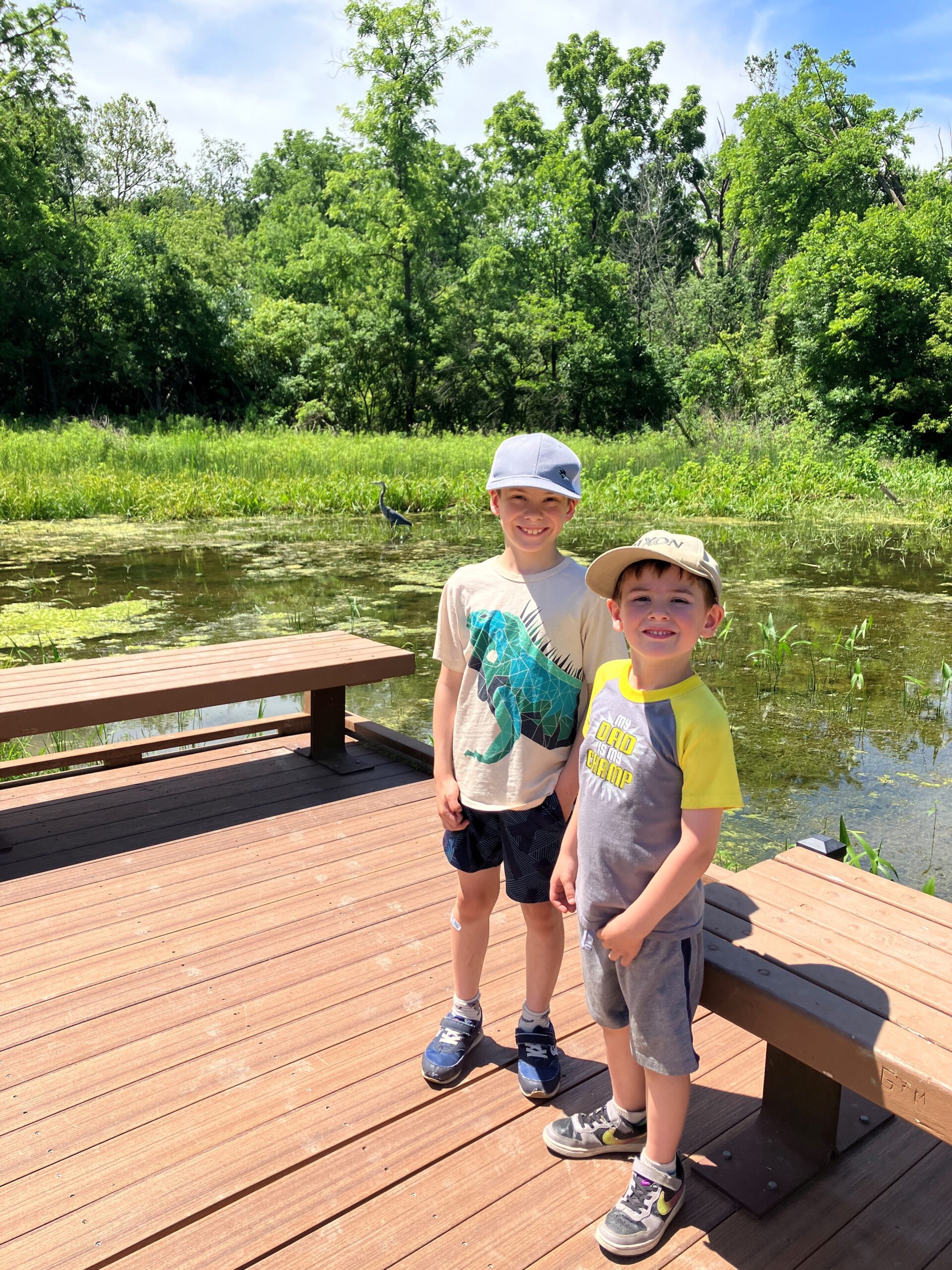
In the manual of things my children have taught me, one of thickest chapters is about the gift of slowing down. Mind you, I haven’t always seen this as a gift, especially when there are realities like clocks and deadlines and tardies and hard stops. Since becoming a mom, I’m slower than I used to be. But to my surprise, this has an unexpected upside. Turns out, there’s a lot more to notice in a lower gear.

As Barbara Brown Taylor says, “The child has only recently learned how to walk, so she still knows how.” My kids know things I need to relearn, like how to spot a roly-poly on the sidewalk or how to hear the hum of an airplane overhead. When I’m rushing from A to B, or when my mind is borrowing trouble from the past or the future, I tend to miss the beauty right under my nose. 

There are a lot of possibilities when it comes to slowing down, but for me, one of the surefire ways is to be literal about it: to choose a slower mode of transportation.

When we’re riding our bikes instead of driving, we notice the flash of fuchsia flowers tucked among the dandelions.

When we’re walking instead of getting around on wheels, we see our neighbors on their front porch and stop to say hello.

When we’re reading on a blanket on a sunny afternoon instead of going places, we leave enough space for a white butterfly to land beside us.

It’s true that technology can make us more efficient. It can get us there faster and without breaking a sweat. But no chatbot has the heart required to write a love letter. No blue glow can take the place of a field of lightning bugs on an August evening. A phone can’t hold your hand while you look for the Big Dipper.

I am grateful for the added margin technology can create in our lives. But what will we miss out on if we erase the struggle altogether? What will happen to our souls if we outsource the ability to create? What will atrophy inside us if we lose the ability to wonder? If not us, who will stand amazed under a starlit sky? How will we hear the still, small voice of God if we always have earbuds in?

Today, I resolve to be bored. To not know. To daydream. To find shapes in the clouds. To embrace mystery. To be blissfully inefficient.

And when I’m tempted to say things like “Hurry up,” may I instead say, “Thank you.”

Above all, trust in the slow work of God.
Pierre Teilhard De Chardin
Leave a Comment Filed Under: Seasons Tagged With: childhood, noticing, savoring, summer, technology
Share on facebook
Facebook
Share on email
Email
Share on twitter
Twitter

November 20, 2025

At the Pace of Four-Leaf Clovers

For my birthday this year, I had one request: to go on a fall hike as a family. I wanted to walk until the buzz of world events, work deadlines, laundry, and homework packets faded, replaced by chirpy crickets, crunchy leaves, and scampering squirrels.

The thing about slowing down, though, is that it doesn’t happen automatically, particularly once you’ve clocked several decades around the sun.

Daniel and I had a route planned out for our hike—and a pace that accompanied it. Our boys had other ideas. “Let’s find a four-leaf clover!” they said, plopping down in the middle of the trail.

I have never found a four-leaf clover myself. I’m not sure there’s an art to it as much as there’s a pace to it. It’s hard to find one at the pace of a car, for example, and it’s equally hard to find one when you’re going at the pace of running-a-few-minutes-late or the pace of too-little-margin.

I’m no horticulturalist, but I have a hunch the conditions for finding a four-leaf clover have less to do with weather or longitude or precipitation and more to do with how fast you’re moving. Maybe the secret is to slow down, to sit down, to let the sun rays kiss your shoulder. And maybe it’s not so much about luck as time. As my kids are teaching me, the only way to accept the gift of time is to downshift my speed. Otherwise, I just might walk past (or step on) the very thing I’m looking for.

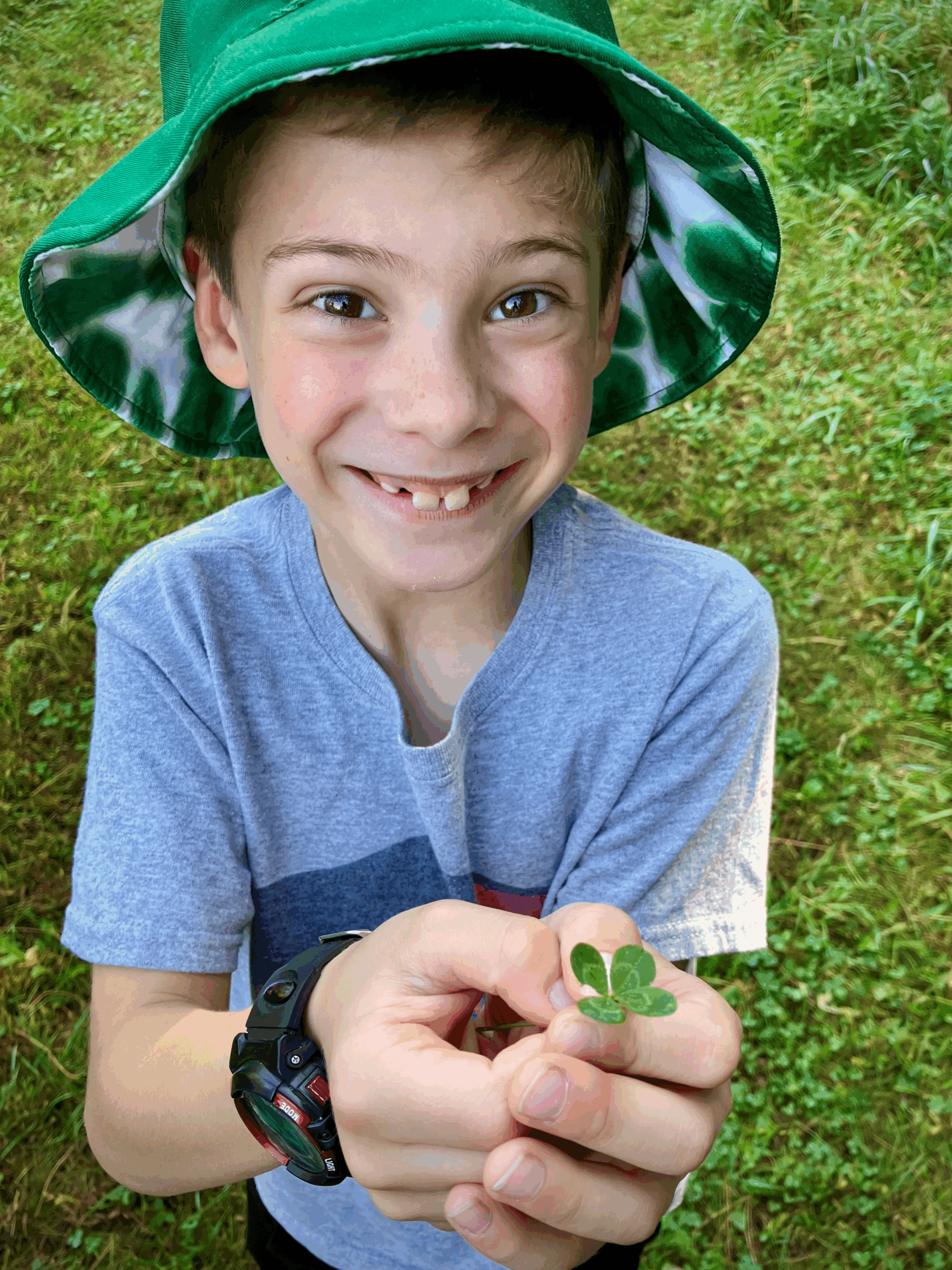
I tried to temper my boys’ expectations, wanting to shield them from disappointment. But sure enough, after some unmeasured minutes of sitting smack dab in the middle of the trail, our eight-year-old found a tiny four-leaf wonder—a treasure for his treasure box.

I experienced a wonder that day too—a glimpse into the “unforced rhythms of grace,” as Eugene Peterson puts it. The treasure I brought home was less tangible but no less real. It was the smile that radiated from my boy’s face like the October sun.

Teach the children. We don’t matter so much, but the children do. Show them daisies and the pale hepatica. Teach them the taste of sassafras and wintergreen . . . head them upstream, rejoice as they learn to love this green space they live in, its sticks and leaves and the silent, beautiful blossoms. Attention is the beginning of devotion.

Mary Oliver, Upstream

2 Comments Filed Under: Seasons Tagged With: creation, four-leaf clover, hiking, nature, noticing, Sabbath, slowing down, wonder
Share on facebook
Facebook
Share on email
Email
Share on twitter
Twitter

May 1, 2023

Tulip Season

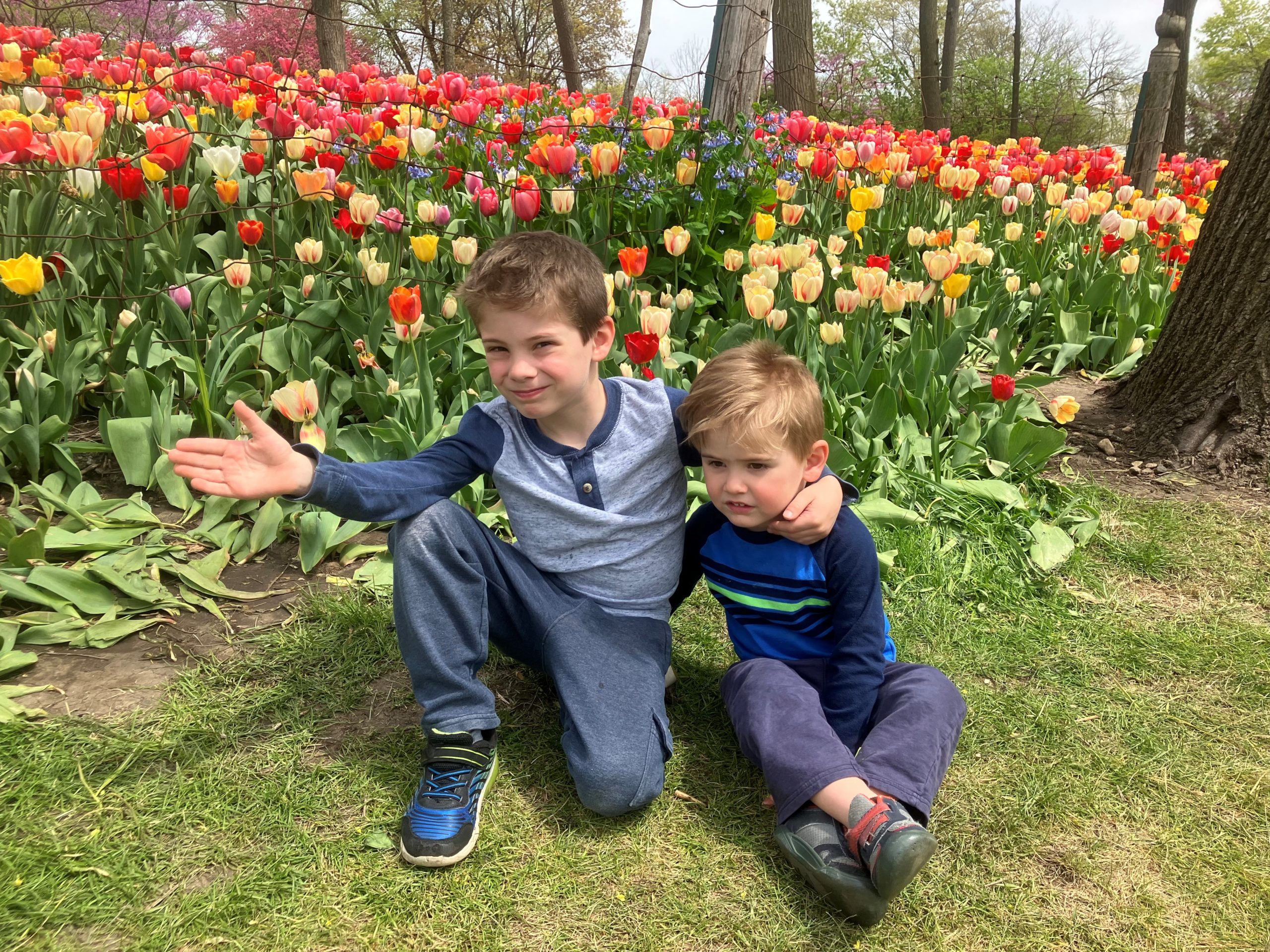
“The tulip field,” he said,
Eyes puppy-wide,
Though I almost missed them on account of my screen.
Not today, I thought,
The inbox as full as the sink as the laundry basket as my List of Very Important Things.

It was the pants that caught my eye.
An inch higher than last week, I swear. His brother’s too.
Everyone warned me this would happen, of course.
The way they shoot up, faster than a field of dandelions, without my assent.

By the time spring comes again, I wonder,
Will you be driving a car, getting a job, calling to check in on a Sunday evening?

So I trade deadlines for hastily slathered peanut butter sandwiches
And we picnic with the tulips.

For tulips bloom bright and brilliant,
But the season is short—
Like morning fog.
Like blinking.
Like last year’s pants.

6 Comments Filed Under: Seasons Tagged With: childhood, motherhood, parenting, seasons, Spring, tulips
Share on facebook
Facebook
Share on email
Email
Share on twitter
Twitter

August 13, 2021

Buy the Land

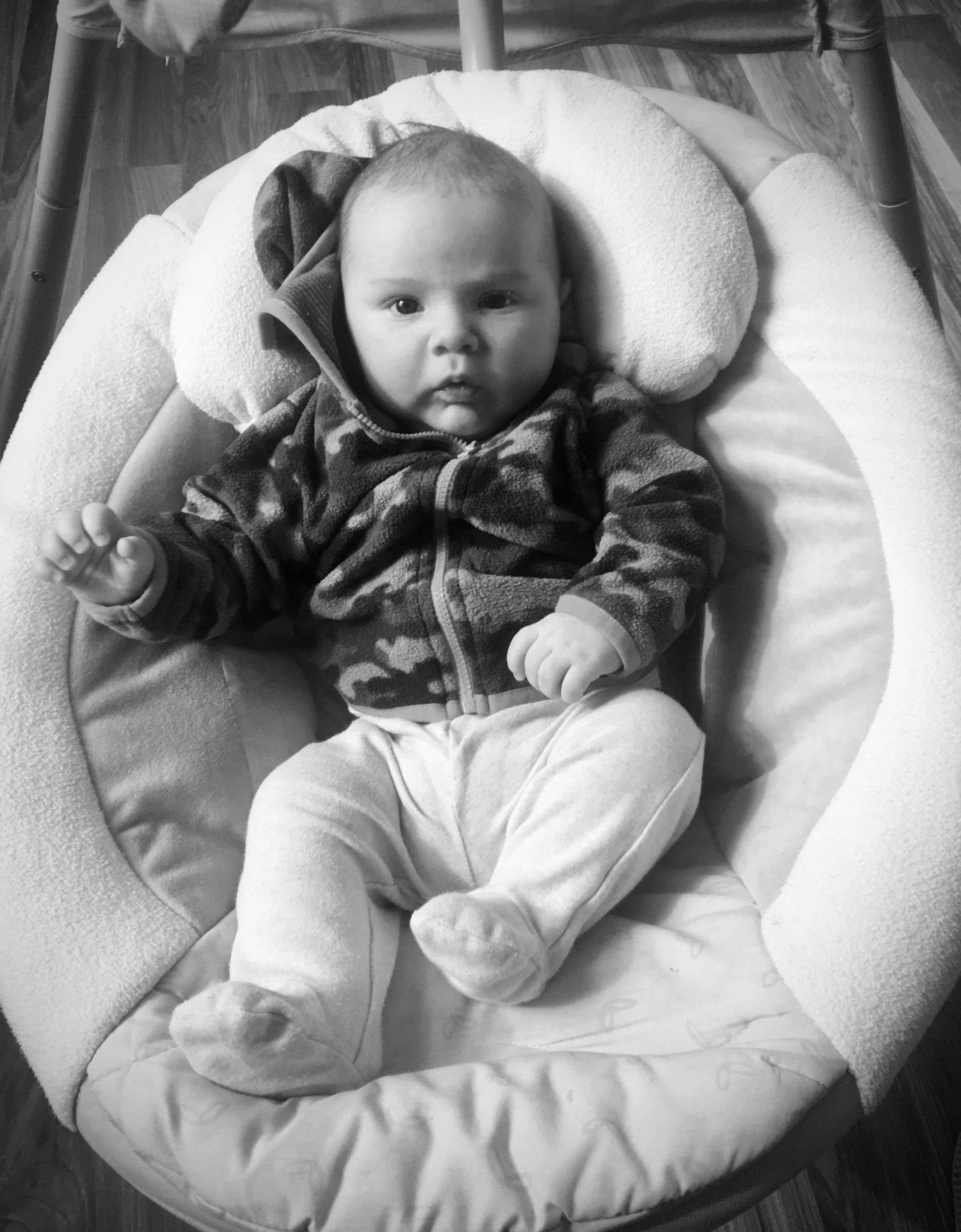
I just packed away a piece of baby furniture. This always comes with a whiff of nostalgia—there’s not much warning when one stage ends and another begins. We take pictures of beginnings—the first step, the first bite of peas—but endings aren’t usually so ceremonious. The change happens gradually until one day we realize, Hey, when did he get too big for that bouncy chair?

But this ending felt even more nostalgic than most, because this was no ordinary bouncy seat. It was my Jeremiah-inspired bouncy seat.

The scene, two years ago: I was on the wrong side of 40 and had gone through a miscarriage after having our first son. We were coming up on a year after that loss, and I wondered if it was time to throw in the hope towel and accept that we would have only one child.

Around this time we got a recall notice for Graham’s bassinet. We could no longer get a reimbursement or a direct replacement, but they would send us another product of our choice. I tried not to think too much about the fact that BABIES HAD DIED IN THE VERY BASSINET MY SON HAD SLEPT IN and started scanning the catalog for something suitable for a toddler.

Before I placed my order, however, I was frozen in place by a passage from the book of Jeremiah.

Here’s the context: God’s people were under attack by the Babylonians, and the prophet Jeremiah was in prison. God had just given him a message that his beloved city would fall; the Israelites would be defeated and deported to enemy territory. In other words: it was the worst possible time for a real estate acquisition.

But that’s exactly what God asked him to do: buy a field in his homeland, the one that was about to be conquered.

Jeremiah said:

Though the city will be given into the hands of the Babylonians, you, Sovereign Lord, say to me, “Buy the field with silver and have the transaction witnessed.”

Jeremiah 32:25

Why would God tell Jeremiah to do such a thing? Why waste money on land that’s about to be seized by your archnemesis?

In a word: hope.

God was saying, essentially, “One day my people will return to this land. Even after the worst happens, there is still reason to hope.”

It’s one thing to give a theoretical nod to hope. It’s another to invest in it with real dollars. God might as well have been telling Jeremiah, “Put your money where your hope is.”

Meanwhile, God was whispering in my own ear: Buy the field. This wasn’t a time to be practical; it was a time to hope.

At first I fought the nudge. What if we ordered a baby item and never had occasion to use it? Wouldn’t it hurt to keep stubbing my toe (and my heart) on it every time I went to the basement?

But the whisper wouldn’t go away: Buy the field. (Or the bouncy seat. Whatever.)

And so the chair sat in the basement, along with my hope, for some time.

It was risky, to be sure. We had no guarantees that the chair would get filled. But we did have a guarantee about God’s heart. So we waited and we hoped, the best we could.

I want to be the first to acknowledge that hope doesn’t guarantee a happy ending. We don’t always get the yes we long for. But in this case, God graciously brought us back to the field we’d bought. He filled that bouncy chair with an even bouncier boy.

And we can’t help ourselves: sometimes we still call him Baby Hope.

Hope acts on the conviction that God will complete the work that he has begun even when the appearances, especially when the appearances, oppose it.

Eugene Peterson

14 Comments Filed Under: Seasons Tagged With: baby, hope, Jeremiah, miscarriage
Share on facebook
Facebook
Share on email
Email
Share on twitter
Twitter

June 4, 2021

Idle and Blessed

I played hooky from work yesterday. It was one of those late-spring mornings that beckoned, all blue skies and sweet lilac air. The boys were crabby and craving attention, and I wasn’t making much headway on my deadlines anyway. So we grabbed hats and sunscreen and headed out for a hike on a trail near our home.

Our destination: a modest cave that doesn’t even warrant a name. At its entrance is a faded sign that reads simply, “Cave.” But for a three-year-old, it was magic.

Graham packed his little blue backpack with a flashlight and a snack. “Mama, do you think bears like fruit snacks?”

We explored the cave, barely big enough for a grown-up person to stand up in. To Graham’s simultaneous disappointment and relief, we didn’t find any bears. But along the way, we did see butterflies and bugs, ducks and dandelions, sticks and squirrels.

As we headed home, I thought about Mary Oliver’s poem “The Summer Day”:

I don’t know exactly what a prayer is.
I do know how to pay attention, how to fall down
into the grass, how to kneel in the grass
how to be idle and blessed, how to stroll through the fields
which is what I have been doing all day.
Tell me, what else should I have done?
Doesn’t everything die at last, and too soon?
Tell me, what is it you plan to do
With your one wild and precious life?

Mary Oliver

As I looked in the rearview mirror at the boys nodding off in their car seats, it occurred to me:

Who better than a toddler to help me relearn how to pay attention?
Who better than a person under three feet to show me how to fall down into the grass?
Who better than a baby with leg rolls and a solitary cheek dimple to show me what it looks like to be idle and blessed?

Parenthood has revealed to me that everything does indeed die at last, and too soon—the baby’s propensity to giggle uproariously before the tickle even lands, the look of milk-drunk bliss on his face after he eats, the way he rests his right hand under his head when he sleeps. The toddler’s ability to create a world where Toy Story characters pretend to be lions who also happen to be fighting a fire; the way he tells Milo daily, “I love you so much, little bwother. I’m going to keep you.”

And it hits me: We will never have a summer when they’re three-and-a-half and six-months-old again. We have this one wild and precious summer. What is it we plan to do with it?

If there’s a common refrain to the parenting advice I hear, it’s this: Enjoy it, because it goes fast. I’m always left a little stymied by these words. Because when you have little people in your life, the momentum is always pulsing forward. There’s no pausing, no slowing down, no going back. How do you stop a speeding locomotive whose brakes have been disabled? How do you hold back a cascading waterfall with your bare hands?

I don’t know how to slow time down. I only know how to slow myself down.

And so this summer we will go on hikes in the woods. We will shine our flashlights into caves like the mighty bear hunters we are. We will flagrantly disregard our phones, our deadlines, our dirty toilets, our drive for productivity, our tyrannical to-do lists. We will kneel in the grass. We will collect sticks. We will look for butterflies. We will fail. And we will find the grace to try again.

So if you are looking for me on a summer day, you just may find me strolling through a field, a child in each arm.

Won’t you join me?

***

Work is not always required. . . . There is such a thing as sacred idleness, the cultivation of which is now fearfully neglected.

George MacDonald

6 Comments Filed Under: Seasons Tagged With: baby, George MacDonald, idleness, Mary Oliver, nature, savoring, Seasons, summer, The Summer Day, toddler
Share on facebook
Facebook
Share on email
Email
Share on twitter
Twitter

May 21, 2021

Split in Two

To be a woman, I would contend, is to feel split in two. Maybe you’re juggling home and career, or marriage and friends, or kids and calling. Whatever the scenario, we all know what it’s like to try to keep the plates spinning without breaking the ones we care about most.

There’s a famous story about a wise king who settled a dispute by offering to split a baby in two split a baby in two. As the story goes, there was one baby and two women, each claiming the child was hers. Solomon called for a sword and said, “Cut the living child in two and give half to one and half to the other.”

At this point in the story, every person with a beating heart cries, “Stop!”There are no circumstances that justify a split-in-two baby. No one wins if Baby is dead.

But what about when it’s the mom who’s split in two?

I recently returned to work after maternity leave, and it seems that wherever I am, I have to leave a piece of myself behind. When I’m at work, my heart is still tethered to the 15-pound cheeky boy who is currently doing tummy time without me and the 3-year-old I promised to build an excavator with when I get back. When I’m at home, I can’t help but wonder what emails are piling up and if my brain will ever recover from its current porridge-like state.

And it’s not just working moms who find themselves tugged in different directions. There are women who are at home full-time while trying to pursue something they feel called to. There are women sandwiched between two generations, caring for kids as well as aging parents. There are single women who are trying to figure out how to follow their passion while also covering the bills.

Some days it feels like there just isn’t enough of us to go around. Not enough energy, not enough time, not enough emotional bandwidth. We need the wisdom for Solomon for this. Is the answer to split ourselves into two (or three or four or five)? If we do, will there be enough of us to go around?

The reality is, it will never work to cut ourselves in half—no matter how sharp the sword or how accurate the slice. We’ll keep giving pieces away until there’s nothing left . . . and it still won’t be enough.

So what’s the answer?

I don’t think there’s an easy solution to this—we may have to reconcile ourselves to living in some amount of tension. But I am learning, by baby steps, that there’s peace in bringing our whole selves wherever we are. Instead of becoming fragmented—separating our work selves from our home selves, our mom selves from our professional selves, our daughter selves from our adult selves—what if we stitched our roles together so we could be all there, wherever we are?

I used to think of integrity strictly in terms of moral uprightness. But what if integrity is about being fully integrated—being the same person, no matter where we are?

I’m still figuring out what this looks like. But maybe it means bringing my editor-self to my parenting and using multi-syllabic words with my toddler. Or bringing my mother-self to my work and letting my baby crash my Zoom calls on occasion.

I wonder what this looks like for you, beautiful woman being tugged in different directions. How are you wrestling with the split-ness of being a woman? What might it look like for you to bring your whole, integrated self to each role you’ve been called to?

However we’re feeling split, may we stitch each part of ourselves together so we can fully love, fully live . . . and be fully ourselves.

The glory of God is a human fully alive.

Saint Irenaeus

6 Comments Filed Under: Seasons Tagged With: babies, children, Family, identity, maternity leave, motherhood, roles, toddlers, women, work
Share on facebook
Facebook
Share on email
Email
Share on twitter
Twitter

February 25, 2021

Unlearning My To-Do List

It turns out that a person doesn’t necessarily need to be able to speak coherent sentences to be an effective tutor. Case in point: the pint-sized spit-up machine who is currently teaching me that sometimes being is better than doing.

I am a planner by nature. I like to make lists and, even better, cross things out. I enjoy the anticipation of thinking ahead…dreaming and scheming for tomorrow or next week or next month.

But when your schedule revolves around a twelve-pound person who can’t think about the future beyond I’m hungry, I’m sleepy, or I’m poopy, planning ceases to be very effective. You don’t know if the baby will nap (or for how long). You don’t know if he’ll wake up smiley or moody or you’d-better-hold-me-or-I-will-scream-like-a-banshee.

And so my tutor reminds me that sometimes we need to set the to-do list aside. Perhaps that’s one of the things children know that we grown-ups have forgotten: we can’t live in the future. We have only been given today. Children (and those with childlike hearts) have a way of inviting us—practically daring us—into the sacred now.

My little guy wordlessly tells me what God has been trying to say to me all along: that while there’s merit to hard work, it doesn’t define me. My worth isn’t predicated on my productivity. My identity isn’t determined by the number of things I crossed off (or didn’t cross off) my to-do list.

In the quiet hours of the night, after my little one is full and content, I sometimes hold him for an extra moment before stumbling back to bed. I marvel at the way he nestles perfectly into me, with his head tucked under my chin and his limbs curled up against me. I’m all too aware, the second time around this parenting rodeo, that he won’t fit there for long. I’ll blink and his arms and legs won’t fit on my lap. I’ll turn my head for a moment and he will be much too sophisticated to snuggle with his mama.

And so I try to soak in the moments as they come. Not every moment, because heaven knows it’s only possible to savor things one drop at a time, not when they come in a virtual tsunami. But I will try to seize the little moments—a dimpled smile, a tiny sigh, a contented gurgle—and freeze-frame them in my heart.

So maybe we don’t need to throw out the to-do list altogether. But perhaps we’d be better off if we could lose track of it for a bit. If we could look into the eyes of the person we’re with and be all there. In the sacred now.

I have calmed and quieted myself, like a weaned child who no longer cries for its mother’s milk. Yes, like a weaned child is my soul within me.

Psalm 131:2

4 Comments Filed Under: Seasons Tagged With: babies, being, children, identity, present, productivity, savoring
Share on facebook
Facebook
Share on email
Email
Share on twitter
Twitter

December 21, 2020

No Room

When I was at the doctor’s office for a prenatal visit recently (something that is beginning to feel like a part-time job these days), I came across a diagram with two side-by-side images, one depicting the internal organs of a woman before pregnancy, and one with a child inside.

I was stunned to see the way the pregnant woman’s insides shifted and squished into odd pockets to accommodate her new resident. The bladder, I noted with special interest, was tucked underneath the baby and all but flattened. This explains so much!

I think about Mary and Joseph knocking on door after door in Bethlehem, looking for someplace that would accommodate them, only to hear over and over, “No room.” I wonder if Mary felt a twinge of irony at those words as she looked at her extravagant belly. You want to hear about no room? Please talk to my gallbladder!

But there’s a secret about hospitality—one that a woman great with child knows in an intimate way: There is never room. You have to say yes and trust that the space will grow to accommodate your guest.

True hospitality means you don’t wait until you have a bigger house, a bigger budget, a bigger heart. You don’t wait until you have more time, more margin, more furniture. You extend the invitation in faith, and trust that your space will expand, proportional to the need.

This Christmas, hospitality looks very different than it does most years. For most of us, there won’t be large gatherings, holiday parties, dinners with friends. So what does hospitality mean in the face of a pandemic and social distancing? Maybe, in reality, hospitality is smaller in scope than we think. Maybe it’s simply about making room within our crowded lives for someone who needs a little love.

This year, maybe hospitality looks like loving the people directly in your bubble. Maybe it means setting aside your crowded to-do list and making space to listen or play with Legos or whisper a prayer. Maybe it means expanding the borders of your heart to love someone who isn’t particularly lovable. Maybe it means saying yes to something you know is right before you’ve figured out exactly how to pull it off.

Maybe hospitality means saying yes before the space is there, before the energy is there, before the love is there . . . and trusting that God will make a space where there wasn’t any before.

Into this world, this demented inn in which there is absolutely no room for him at all, Christ comes uninvited.

Thomas Merton

3 Comments Filed Under: Seasons Tagged With: Advent, Christmas, hospitality, incarnation, pregnancy
Share on facebook
Facebook
Share on email
Email
Share on twitter
Twitter

December 14, 2020

Those Twins, Hope and Fear

In the midst of Advent, we find ourselves in the space between.

Between the promise and the fulfillment.
Between the announcement and the arrival.
Between the almost and the not-yet.

There is beauty in the in-between time, as we light candles and imagine a future of fulfilled hopes. But there is also trembling, as we put our most vulnerable dreams on the line, crowded by so much uncertainty.

I’m reminded of that haunting line from “O Little Town of Bethlehem”:

The hopes and fears of all the years
Are met in thee tonight

O Little Town of Bethlehem

As anyone who has ever waited knows, true Advent isn’t just opening windows on a calendar, ticking off the days until Christmas. Waiting is full of hope, yes, but it’s also fraught with angst. There is so much we don’t know: When? How long? How? And what will the waiting cost?

As we count down the days until we meet our baby, we find ourselves in an Advent of our own. When will Baby arrive? How much longer will our waiting be? Will we know when it’s time? What will we find on the other side of our waiting?

There’s a poem by John Donne that includes this gem of a line:

Pregnant again with th’ old twins, Hope and Fear

John Donne

And that’s exactly what waiting feels like, what Advent feels like: hope and fear, mingled inextricably together. We can’t have one twin without the other. We have no choice but to carry the weight of both.

But from where we stand, on the other side of the Incarnation, we have a hint about how the story ends. While we will contend with both hope and fear as long as we live on this earth, one day fear will be swallowed up forever. One day hope will win.

And so we let those twins wrestle inside us as we wait, knowing that Christ’s birth ushered in an era of hope. And when he returns, all our hopes will be forever met in him.  

The Incarnation is the place, if you will, where hope contends with fear.

Kathleen Norris

8 Comments Filed Under: Seasons Tagged With: Advent, baby, Christmas, fear, hope, pregnancy
Share on facebook
Facebook
Share on email
Email
Share on twitter
Twitter

December 8, 2020

The Risk of Love

I was talking to a friend the other day about how terrifying this world can be. She agreed and then said something I’ve been thinking about ever since: “I wonder if every decision we make is motivated by either fear or love.”

Love in any form is risky. But when you love a pint-sized human being, you begin to realize just how vulnerable your heart is and how little control you have. You would step in the path of a raging mountain lion for this little person; you would take a bullet headed their way; you would jump into the rapids to save them . . . and yet there are approximately 79 ways they could die before breakfast. And that’s to say nothing of the ways they could rebel against you or reject everything you hold dear or otherwise break your heart.

To the pragmatic mind, love seems like a fool’s choice. Surely the risk is too great, especially when there’s no guarantee about the outcome. If our decision is based on fear, we’ll never put our hearts out there to get trampled. But if our decision is motivated by love, we will have the courage to make the scary, risky leap of love.  

Mercifully, we have a God who didn’t just command us to love; he took the risk of love himself. Madeleine L’Engle captures this idea of love incarnate in her poem “The Risk of Birth.”

This is no time for a child to be born,
With the earth betrayed by war and hate
And a comet slashing the sky to warn
That time runs out and the sun burns late.

That was no time for a child to born,
In a land in the crushing grip of Rome;
Honour and truth were trampled by scorn—
Yet here did the Saviour make his home.

When is the time for love to be born?
The inn is full on the planet earth,
And by a comet the sky is torn—
Yet Love still takes the risk of birth.

Madeleine L’Engle

Bringing love of any kind into the world is fraught with risk. Hurricanes strike. Bombs drop. Cars crash. Doctors bear bad news. The world shifts under our feet. When is the time for love to be born?

So I guess it comes down to this: Don’t wait for the conditions to be right. Take the risk of love. Take the risk of birth. If God himself became love incarnate when it was no time for a child to be born, then we, too, can love . . . even when the timing is all wrong.

12 Comments Filed Under: Seasons Tagged With: Advent, fear, incarnation, Love, Madeleine L'Engle, risk
Share on facebook
Facebook
Share on email
Email
Share on twitter
Twitter

  • 1
  • 2
  • 3
  • …
  • 7
  • Next Page »
welcome_stephanie_rische

Welcome!

I’m so glad you stopped by. I hope you will find this to be a place where the coffee’s always hot, there’s always a listening ear, and there’s grace enough to share.
  • Email
  • Facebook
  • Pinterest
  • Twitter

Personal Delivery

Sign up here to have every new post, special newsletters, and book club news delivered straight to your inbox. (No carrier pigeons will be harmed in this delivery.)

Free eBook

20 Days of Prayers...just for you!
Submit your email to receive a FREE copy!

    Recently

    • A Letter to Our Son on His 9th Birthday
    • In Praise of Inefficiency
    • When the World Is on Fire
    • A Letter to Our Son on His 5th Birthday
    • At the Pace of Four-Leaf Clovers

    Book Club

    • August 2018
    • July 2017
    • April 2017
    • November 2016
    • August 2016
    • March 2016
    • March 2016
    • December 2015
    • September 2015
    • July 2015
    • May 2015
    • January 2015

    Favorite Categories

    • Friday Favorites
    • Grace
    • Literature
    • Scripture Reflections
    • Writing

    Other Places to Find Me

    • Faith Happenings
    • CT Women
    • Boundless
    • Single Matters

    Connect With Me

    • Email
    • Facebook
    • Twitter
    • Pinterest

    All Content © 2010-2014 by Stephanie Rische • Blog Design & Development by Sarah Parisi of Parisi Images • Additional Site Credits